
Compliance · 5 min read ·
Your team finished the training. Can you prove who is compliant today?
There is a comfortable assumption in large organisations: compliance is handled. But the bigger you are, the harder one question gets, who is compliant today. Completion is not proof, the gap widens with scale rather than shrinking, and closing it frees compliance teams instead of replacing them. The argument, and what actually closes the gap.

Shreya Malot
Chief Operating Officer, HabileLabs
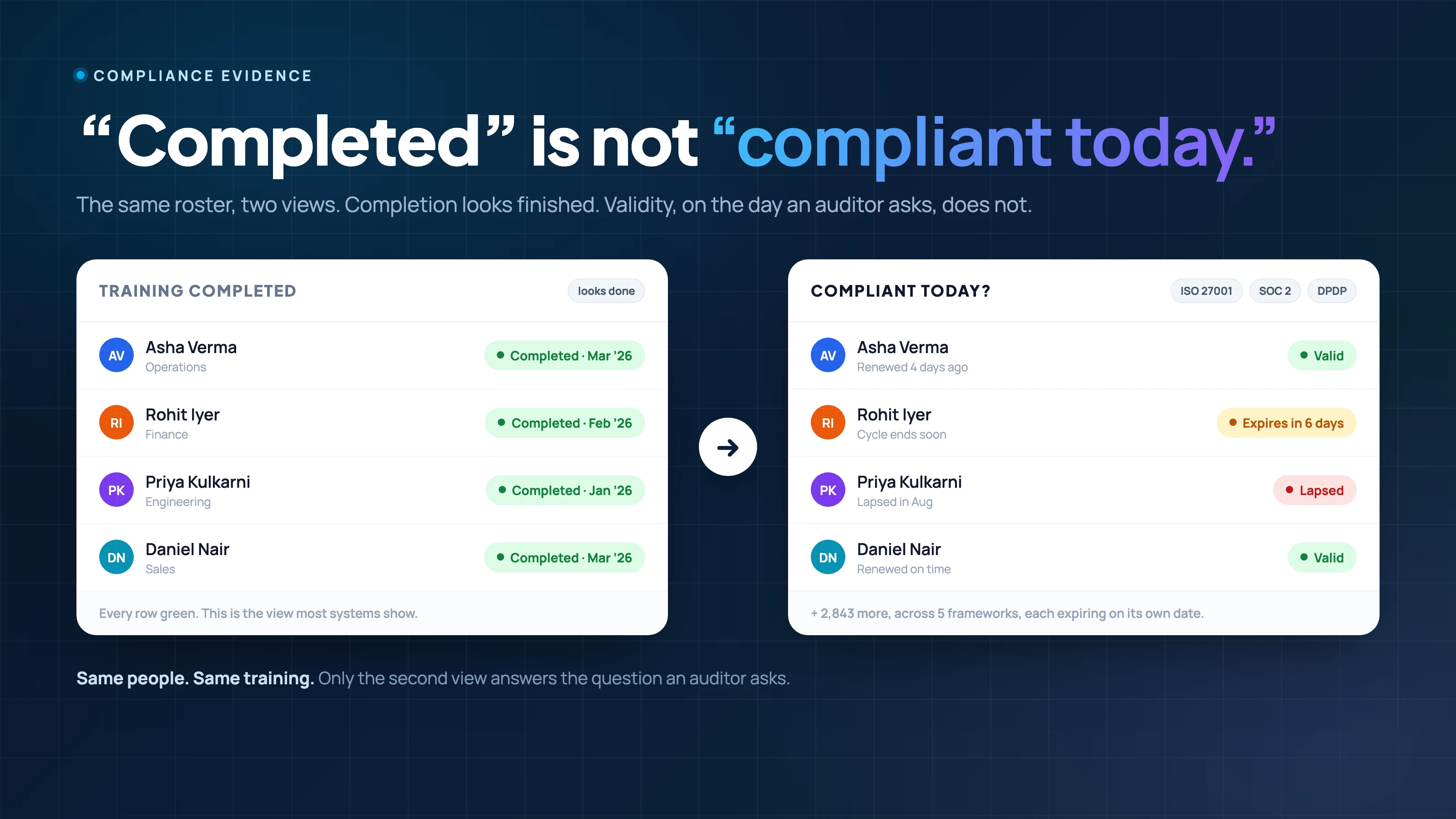
There is a comfortable assumption inside large organisations: compliance is handled, the team has it covered. Here is the uncomfortable version. The bigger you are, the harder one specific question becomes to answer, and it is the exact one an auditor asks. Not who completed the training. Who is compliant today.
Completion is a date. Proof is a state.
Completion records that something happened in the past. A course finished in March, a certificate issued. That is useful for showing effort, and it is what most systems capture. It is not what a regulator, an enterprise customer’s security review, or the Data Protection Board is asking for. They want the current state: on the day of the question, which named people hold a valid, unexpired certification for each obligation that applies to them.
“Completed in March” does not answer that if the certification lapsed in August. Under the DPDP Act, where penalties reach up to ₹250 crore, the gap between the two has stopped being academic.
Why scale makes it worse, not better
The instinct is to treat this as a small-company problem that any serious enterprise has already solved. It is the other way round. A larger organisation has more people, more roles, and more frameworks running at once, ISO 27001, SOC 2, PoSH, DPDP, sector rules, each with its own renewal clock. The number of certifications that must be valid on a given day runs into the thousands, and they expire on different dates.
Headcount does not close that gap. It multiplies it. A well-staffed compliance team can train everyone and still lose the week before an audit reconciling spreadsheets to find who has quietly fallen out of validity. The team is not the problem. The manual reconciliation is, and it gets slower the bigger you get.
The judgment is human. The grind is not.
It is worth being exact here, because “automate compliance” is easily misheard as “replace the compliance officer.” It is not that. The hard part of compliance is judgment: reading the regulation, deciding what good looks like for your organisation, owning the risk when it is not clear-cut. That is senior work, and it stays with people.
What breaks teams is the mechanical work stacked around it: chasing individuals for renewals, re-issuing lapsed certificates, escalating to managers, assembling evidence by hand before every audit. None of that needs judgment. All of it consumes the hours that judgment should get.
What we hear on review calls
The best compliance leaders we work with would rather spend their time on risk than on reminders. The reminders are precisely the part a system should carry.
What actually closes the gap
Closing it means the current state is always known, not reconstructed on demand. In practice it is a few things working together:
- Validity, not just completion. Certifications carry an expiry and lapse on their own, so “valid” is a live fact.
- Renewals chased automatically. The learner before expiry, the manager after, with no chase list to maintain.
- Gaps that surface immediately. Access re-locks the moment a certification lapses, so a gap shows the day it opens, not at the audit.
- One export, any day. Per framework and per person, who is compliant today, generated the same way every time.
The system does the reconciliation. People keep the judgment.
Where to start
You do not need to rebuild your programme to test this. Take one obligation and one group, put it on a system that tracks validity rather than completion, and time how long it takes to answer “who is compliant today.”
We reached this the hard way, through our own audit before any customer’s. That story is here. This piece is the shorter point: the gap is not ours alone, and it is not a small-company one.
Learnify is free to try with 20 seats for 30 days, every feature on, no card. Verify your work email and the workspace creates itself.
Start freeKeep reading
More from the Learnify Journal

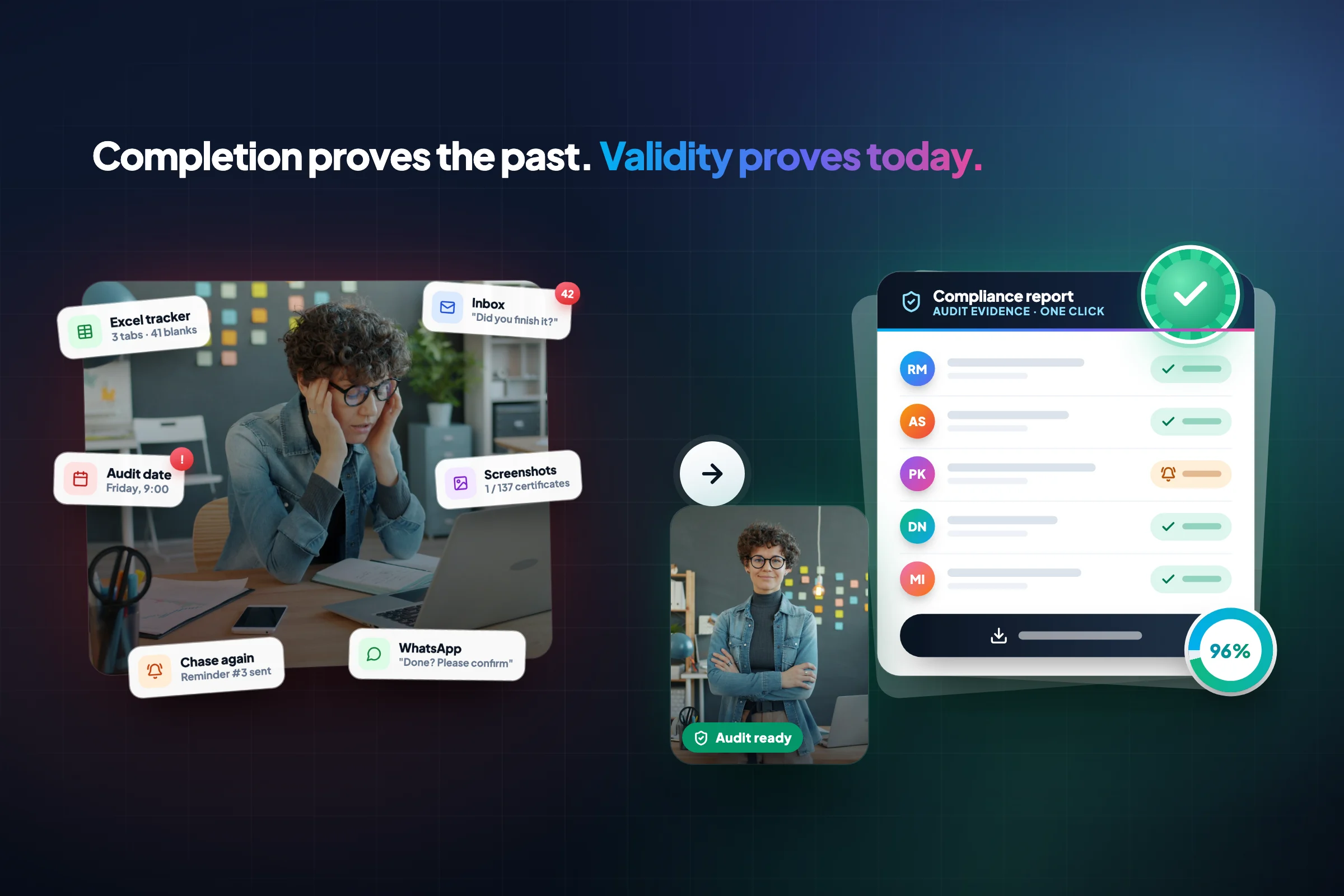

Your next audit should take an afternoon.
Start free and watch the evidence pack export from your own workspace — or book 30 minutes with a solution architect who has sat through the inspection you are preparing for.
info@habilelabs.io
20 seats · 30 days · no card
India · North America · Europe
HabileLabs Cloud, Data & AI